
-
Mza Diamond Resources (Pty)Ltd
is a South African marine diamond mining exploration company.
-
Holds the exclusive diamond rights over a
25km long; 5km wide 7B diamond concession area that covers 100sq/kms of prime diamond costal deposits.
-
The area lies a mere 1000 metres off the coastal plains of the South African West Coast
an area renowned for the extensive high grade diamond recoveries from coastal channel deposits.
-
The 100Sq/KM no 7b diamond concession
falls within the red boundary lines reflected on the map.
MZA DIAMOND RESOURCES (PTY) LTD
The company holds the exclusive right to extract diamonds from the Number 7B mid-water marine concession off the West Coast of South Africa
Fast Facts about Concession Area No. 7B:
Mza Diamond Resources is the holder of the official diamond exploration licence over the mid-water 7B marine diamond concession on the West Coast of South Africa.
The concession is 25 km long, 5 km wide and 100 square kilometers in extent.
It lies adjacent to the famous coastal diamond deposits that has been intensely mined by De Beers and others, over the past 70 years.
At least 7 major submerged gravel filled paleo channels that delivered billions of tons of diamond-rich gravels to the West Coast millions of years ago, has been identified on 7B.
Early indications are that the 7B concession area contains more than 100 million tons of diamondiferous gravel deposits.
Due to historic reasons and a lack of effective subsea mining tools to recover gravels from the mid water area, the 7B concession has never been mined.

ABOUT MZA DIAMONDS
Mza Diamond Resources (Pty) Ltd is the sole holder of the official rights to extract diamonds on Concession Number 7B and is led by marine diamond mining entrepreneur Willem Steenkamp, a third-generation diamond miner.
Willem’s late father, Jannie as well as his grandfather, Lukas, were pioneer diamond miners on the South African and Namibian West Coast. They successfully developed numerous diamond mines over their lifetimes.
Situated off the on the West Coast of South Africa, Number 7B mid-water sea concession is one of the largest privately-owned marine diamond licence areas outside those areas belonging to De Beers and Trans Hex.
Mza Diamonds is a subsidiary of Zone One Diamond Exploration (Pty) Ltd, the operating company authorized to run and manage marine exploration and future mining operations on the 7B licence area.
The 7B concession area is 5 km wide, runs 1 km offshore for 25km along and adjacent to the famous coastal diamond fields on the West Coast of South Africa. The area lies between Mitchells’ Bay mine in the south and the famous De Beers Koinghaas mines to the north.
Over the past 70 years mines on the coastal plains landward of the 7B marine Diamond Area produced millions of gemstone-quality diamonds to world markets.
The diamonds were recovered by De Beers and others from the remnants of old paleo channels that delivered billions of tons of diamond-bearing gravel into the coastal environment millions of years ago.
It is only in more recent times that geologists realized the important role these fast-flowing paleo rivers played in distributing diamonds onto the West Coast millions of years ago.
Side-scan sonar surveys on 7B has revealed that at least seven of these major paleo channels mined By De Beers on the coastal plains adjacent to 7B extended onto and cut across the 7B mid-water shelf during the diamond deposition period eons ago. At the time the coastline was an estimated 3km east (seaward) of the current surf zone.
When the sea levels rose millions of years ago these old fossil river channels were submerged and stopped flowing leaving billions on tons of gravel on the seabed. The gravel was reworked by powerful waves and currents and ended up trapped at the bottom of the paleo channels that were incised into the bedrock of the seabed.
Due to historic reasons, including the lack of effective mid-water subsea mining technology, the 7B diamond concession has never been fully prospected or mined.
This creates unique opportunities for a new breed of subsea diamond miners to utilize new and developing technologies to access and recover diamonds trapped at the bottom of these giant drowned channels filled with diamondiferous gravels.
FUTURE PLANS
Mza Diamond Resources is investigating the deployment of ground-breaking remote-controlled subsea mining equipment to effectively extract diamonds from the mid-water area.
So far, the depth of mid-water deposits, poor visibility and tough weather conditions have made diver-operated recovery methods like those used in the shallower Number A concession areas, unproductive for the deeper mid-water areas.
Large crawler mining tools used in deep sea mining operations are also not suitable for the rugged, channel-incised drowned diamond river valleys in the medium-depth middle water concession areas.
Mza Diamond Resources is convinced that the development of effective remote mining equipment suitable for mid-water depths, will lead to efficient diamond recovery from these enriched areas. These methods will not only increase production but will be able to be upscaled into 24/7 mining operations regardless of sea conditions.
New patented sub-sea remote mining equipment is in the final development stage and Mza Diamonds is in advanced negotiations with the developers of the patented equipment to deploy the first new age mid-water remote mining tool on 7B.
The developers of the tool are keen to deploy their remote mining tool on 7B because the gravel deposits trapped in the old channels historically delivered very high diamond grades from similar channels on the adjacent coastal plains that were so effectively mined by De Beers.
De Beers originally discovered and delineated these channels on the coastal plains by using advanced ground penetrating radar to pinpoint the paleo channel deposits. Sonar surveys on 7B largely mirror the channels discovered and mined by De Beers.
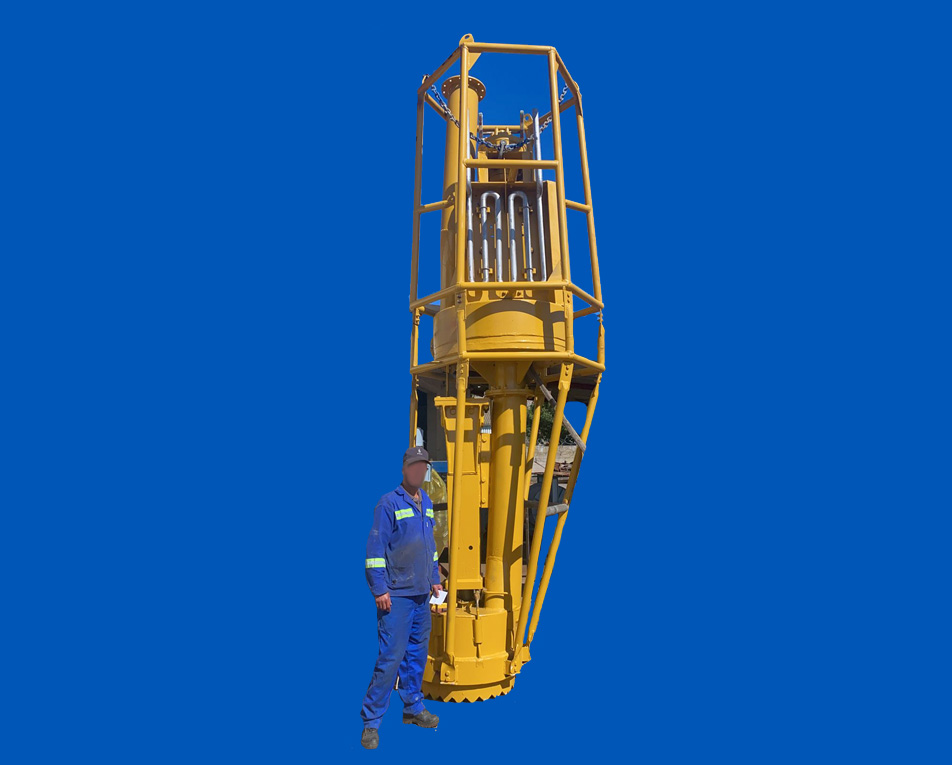
Gravel gobbler: A prototype of a new remote subsea mining tool that could put highly enriched mid-water diamond deposits within reach. The tool will soon be tested on the West Coast.
The Directors of Mza Diamonds: Willem Steenkamp (CEO), Vuyo Bavuma , Junior Steenkamp and JB Steenkamp.
Willem Steenkamp is also the chief operating officer for Zone One Diamond Exploration – the company appointed to manage mining exploration activities on behalf of Mza Diamond Resources. A professional diver Willem tested one of the first diamond recovery pumps on the West Coast in the early 1970s. He also dived and recovered diamonds on 8 shallow diamond concessions on the coast and operated his own diamond recovery vessel on the 7A shallow water concession adjacent to the 7B mid-water area where he first realised the important diamond distributary role of paleo channels.