
THE ORIGIN OF DIAMONDS ON THE WEST COAST
Where do submerged diamond deposits on number 7B mid-water diamond concession come from?
Geologists estimate that vast quantities of diamonds contained in inland kimberlite-rich diamond pipes were scraped up by giant glaciers during an ice age many millions of years ago.
These giant glaciers, acting like huge bulldozers, scraped up and captured billions of tons of diamond-rich gravels and transported the gravel deposits to the coast where warmer conditions melted the glaciers releasing the previously frozen “cargo” of billions of tons of diamondiferous gravels onto the coastline.
Here fast flowing rivers fed by the fast-melting glaciers carried vast gravel deposits towards the west dumping billions of tons of material into the sea. This process continued over millions of years and geologists today estimate nearly 80% of all South Africa’s diamonds ended up in the sea.
The vast amount of gravel released by the melting glaciers scoured deep channels into the bedrock on the coastal plains. Portions of these channels were submerged when sea-levels rose leaving the gravel deposits untouched on the seabed while upriver sections of the channels were pinpointed on the coastal plains and mined for decades by De Beers and others.
until now.
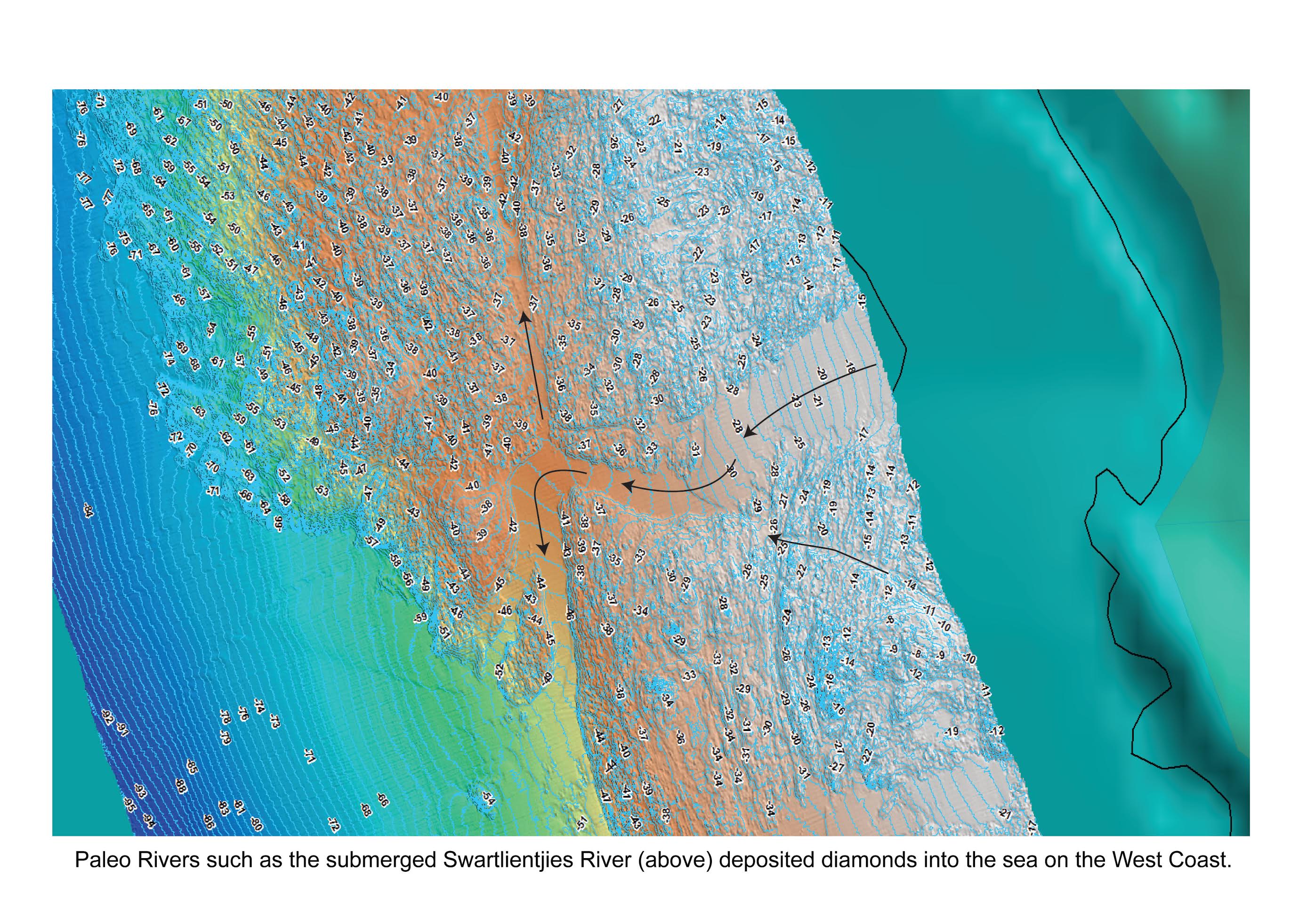
A virtual delta of incised fossil river channels has been identified on this part of the coast and serves as a graphic reminder of very different climate conditions millions of years ago when giant fast flowing rivers carved up the coastal plains delivering billions of tons of heavy minerals, including diamonds, into the marine environment.
As people realized that the old distributary channels originally cut across and deposited millions of carats of diamonds onto what is today the old submerged coastal plains, diver-operated small boats fitted with centrifugal recovery pumps started recovering the highly enriched diamond gravels from the shallower Number A concession surf zone areas, that lie adjacent to the coastal diamond fields.
More recently, geologists realized that the bulk of diamonds transported to the coast millennia ago are still trapped in deeper submerged extensions of the same gravel-filled paleo channels that were originally mined on land by De Beers. The channels have now been found to extend onto 7B where the paleo rivers originally mouthed out. Follow-up dive surveys confirmed the position of the channels on 7B and verified that the channels are filled with diamondiferous gravels.
Remnants of paleo channels mined by De Beer and others on coastal plains adjacent to 7B delivered exceptional grades of more than 370 carats per hundred tons. It is therefore not unreasonable to expect similar grades in submerged sections of these paleo diamond distributary rivers.
Substantial mid-water deposits
The change in sea levels, giant melting glaciers releasing billions of tons of heavy mineral gravels into the marine environment, a vast network of fast flowing paleo rivers that deposited diamonds on part of the West Coast, all played a major role in the deposition of diamonds on the West Coast.
De Beers has shifted its operations from the land to deep (C and D) sea concessions where it deploys giant mining ships that use sub sea crawlers to suck up diamond bearing gravel 24/7. While the diamond grade is not as high in these deep areas the volume of gravel recovered and processed makes it all worthwhile for the mining giant that reportedly now produces more diamonds from its marine operations than production from its land mines combined.
De Beers has acknowledged that the areas likely to contain the highest potential diamond grades are the mid-water B concession areas where paleo gravels lie trapped in channels and potholes. However, it is not safe for its giant floating mines to operate so close to the coast (1 km) while the irregular seabed containing ravines, large paleo channels features, cliff faces, and pothole structures further limit large ship mining operations.
Not all mid-water areas carry notable deposits as only certain parts of the West Coast were fed by giant glacier and a multitude of fast flowing paleo rivers that dumped billions of tons of diamond gravel into the sea.
Number 7B mid-water diamond area has been identified as one such concession area where the existence and role of a multitude of diamond bearing channels have been pinpointed. As far as could be established no other concession area on the West Coast is home to as many paleo depository channels as the 7B licence area.
Small-boat operators working on the adjacent shallow 7A concession have since the early 1970s recovered many thousands of carats of gemstone quality diamonds in areas where subsea paleo channels cut into the sea. This despite only being able to work between four and six days a month because of poor weather and tough diving conditions. (Refer to the 7B boundary map containing shallow water diamond production points).
While De Beers acknowledges that the mid-water probably contains some of the most highly enriched diamond deposits in old paleo channels, potholes, and other trap sites, the rugged mid-water seabed and relatively shallow depth is not suitable for the giant deep-water mining vessels operated by De Beers.
Conversely the lack of effective remote mining equipment suitable for productive mid-water mining operations have to date severely limited successful mining activities in this area. However, new technological breakthroughs in remote mining equipment are now putting these deposits within reach
Geologists are convinced that the vast paleo gravel deposits on the now submerged mid-water shelf contain large quantities of diamonds trapped in crevices, giant submerged paleo river valleys and along drowned coastlines. To date adjacent land-based mines on the coastal plains (previously under the sea) delivered some of the highest diamond grades ever mined – similar results are expected in the 7B mid-water areas.
NEW DIAMOND FRONTIER
Surveys on 7B have identified major paleo gravel deposits. Most of these deposits are contained in old sunken rivers channels that cut across the mid-water area and mouthed out into what is today the old, drowned coastline.
The company is convinced that the deployment of effective remote mining equipment in the mid-water will open a new frontier of diamond discoveries on the West Coast. Until now this area has been largely untapped as depth limitations on divers, poor mining equipment and little geological data limited exploration.
However, more advanced subsea surveys on the Number 7B licence area indicated a multitude of trap-sites, numerous sunken river valleys and the old paleo coastline that existed at the time of diamond deposition on the West Coast. These all offer high-potential diamond targets.
New effective remote mining equipment is expected to finally unlock access to vast deposits in the 7B mid-water area. These deposits trapped in a multitude of paleo channels and other trap sites offers exceptional opportunities.